‘Some Steel’: Sculpture and Steel in Britain, 1960-90
31 January 2026 – 10 January 2027
Leeds Art Gallery
Sculptor Garth Evans describes himself as ‘one of the few people around that didn’t work in steel’ during the late 1960s. Popularised by Anthony Caro and the New Generation sculptors (named after the influential New Generation exhibitions at Whitechapel Gallery, London in the early 1960s), the use of steel came to dominate sculpture in Britain during this period and was closely associated with the sculpture department of St Martin’s School of Art in London, where Evans taught.
While at St Martin’s, Evans completed a fellowship with the British Steel Corporation arranged through the Artist Placement Group, an organisation founded in 1965 that placed artists in government, commercial and industrial settings. New to working with steel as a sculptural material, Evans used the fellowship to visit and photograph steelworks around the country to familiarise himself with various production methods. A selection of his photographs was published by British Steel as the photobook Some Steel in 1971.
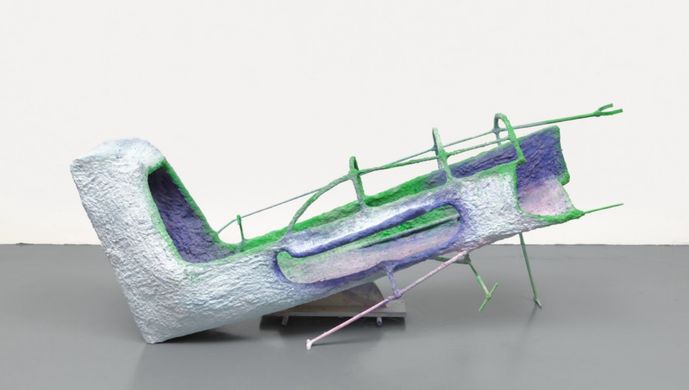
Evans found great difficulty in working with steel. After more than a year of fruitless effort, the large floor-hugging Breakdown 1971 emerged. Made from lengths of hollow rectangular steel, it measured twenty-five feet by twenty-two feet and occupied the entire studio. He used the material again for his public sculpture in Cardiff as part of the City Sculpture Project in 1972. Resembling an industrial tool, the black painted steel sculpture offered an oblique tribute to the coal mining and steel-making industries of South Wales. Steel sculptures by Kenneth Martin and Bernard Schottlander were also sited in Sheffield as part of the City Sculpture Project.
Using steel to connect with industrial heritage and geography was a strategy seen in other public art commissions during the 1980s and 1990s. In Bottle of Notes by artists Claes Oldenburg and Coosje van Bruggen, unveiled in Middlesbrough in September 1993, eight tons of mild steel provided by British Steel formed a ‘bottle’ that recalled the town’s tradition of working with both iron and steel. Despite the decline of the steel industry, the 1990s saw the opening of a dedicated museum for steel sculpture: the Ironbridge Open Air Museum of Steel Sculpture in Shropshire, established by artists Pam Brown and Roy Kitchin.
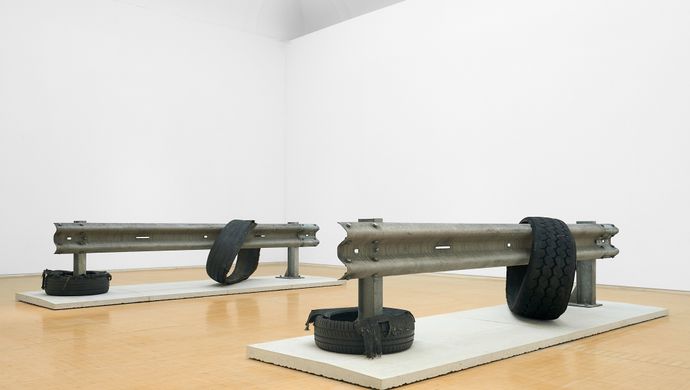
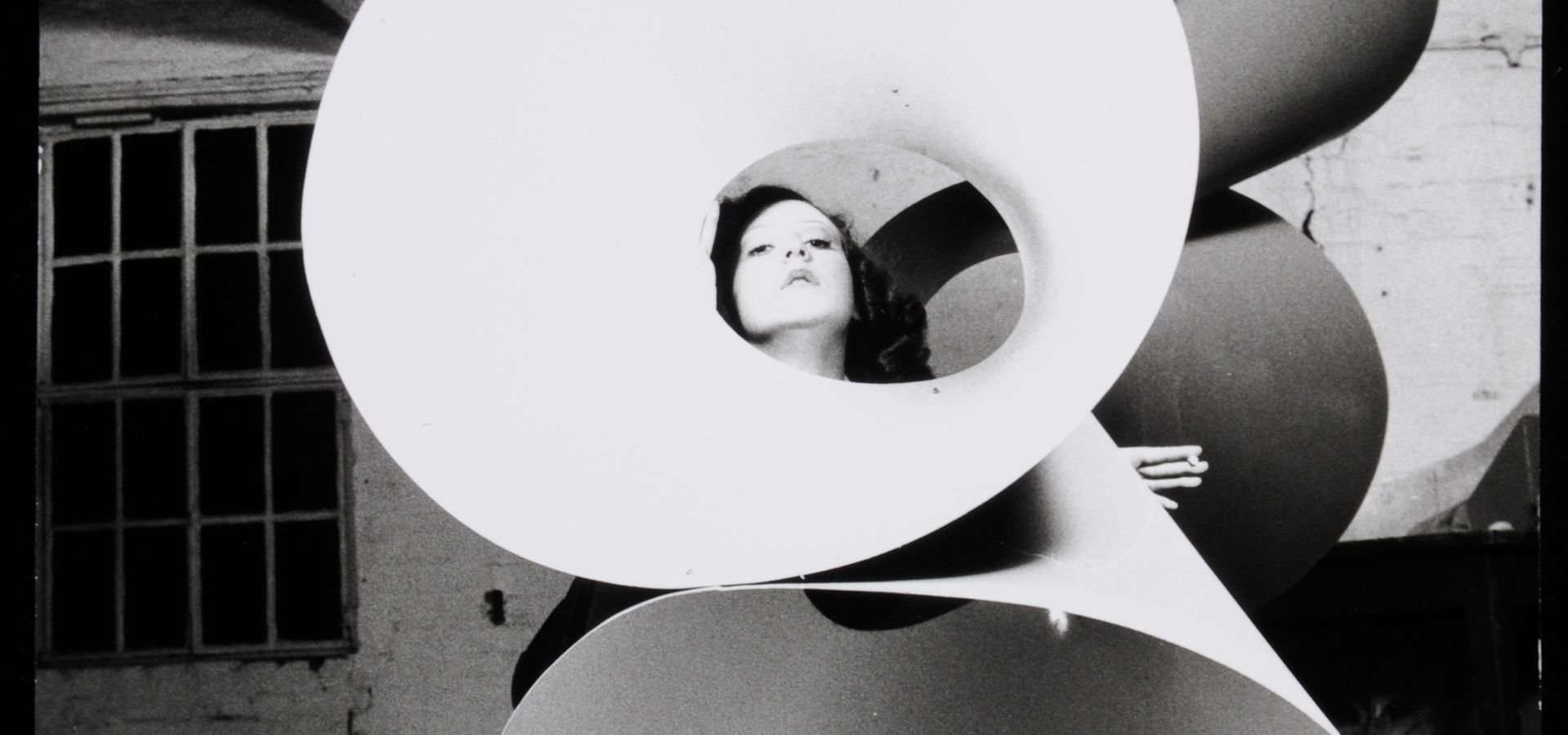
Beginning with examples of the brightly coloured abstract steel sculpture typical of the early 1960s, including works by Neville Boden, this display traces the relationship between sculpture and steel over a period of thirty years, from the gallery to artist-run spaces, to the street and the outdoor museum, from metropolitan London to the post-industrial North.
Image credit: 'Models posing with Neville Boden Sculpture'. Copyright Leeds Museums & Galleries, presented by the Estate of Neville Boden.