
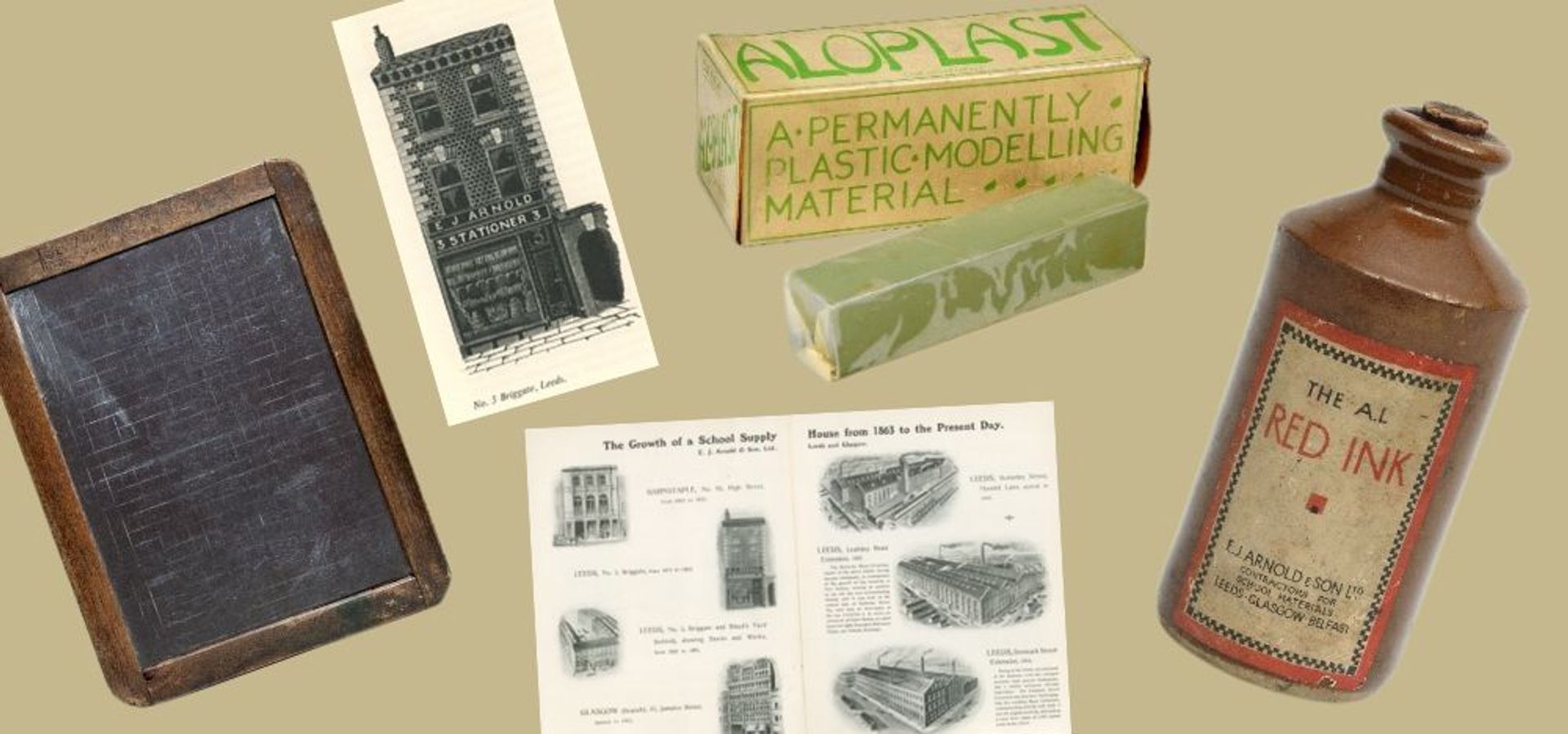
E. J. Arnold and the Foundation of a New Leeds Industry
In 1973, a visit to Leeds by then-Education Secretary Margaret Thatcher somewhat unsurprisingly led to protests in the city. Visits to schools in Beeston and Headingley were marred by student walkouts, while parents protested poor conditions at their children’s schools, many of which were still using ‘temporary’ classrooms which had been set up during the second world war. On this same visit, the Education Secretary opened a new distribution warehouse on Dewsbury Road, owned by the educational supply company E. J. Arnold. Among the controversies, the visit brought attention to a company grown in Leeds over the last century to become the largest and most dominant company in the classroom equipment industry, with unmatched global reach.
1870 marked the start of the British education system as we know it, when a Parliamentary act established local, publicly administered school boards with new taxpayer funding. Before that point, many schools in England had been private institutions or run by religious groups, and places were limited. While the act did not make education free, it did result in an increase of school places available and opened doors to children whose families could not afford the fees of private institutions. This increase in student numbers, combined with new public funding sources, created the perfect environment for a new British industry to thrive – school supplies.
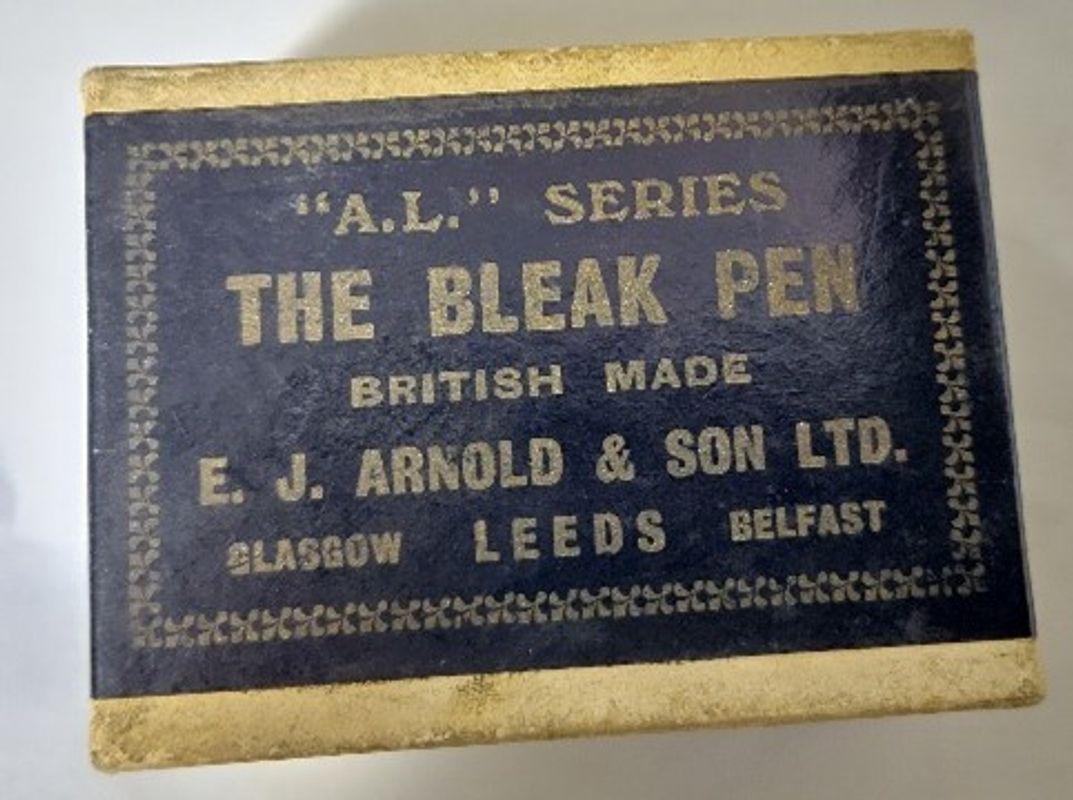
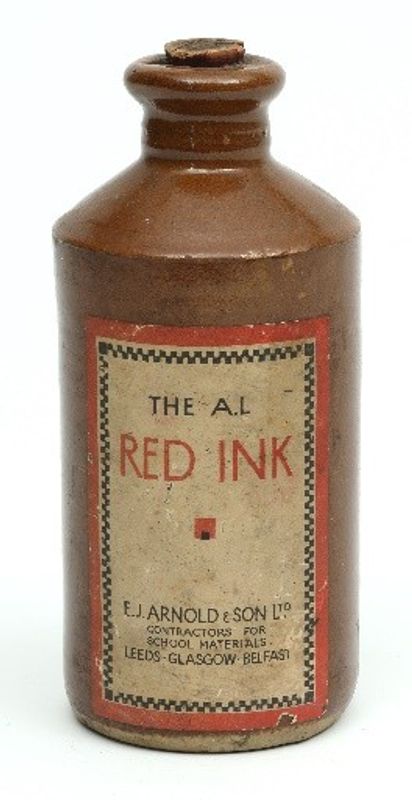
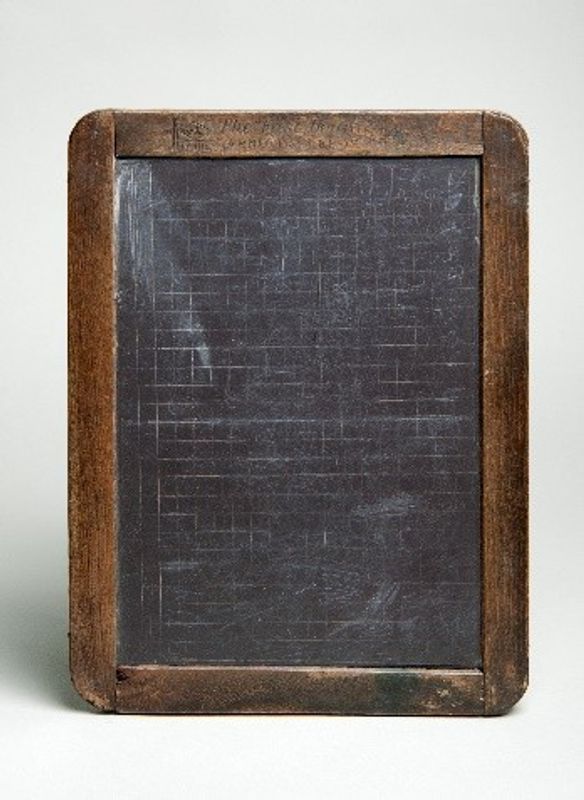
Before the introduction of taxpayer funding in education, school supplies such as books, slates, and classroom equipment were typically paid for by Schoolmasters. Naturally, this resulted in situations where provisions were poor and as the Master sought to preserve his own salary. As such, companies had not yet had the impetus to focus on the large-scale manufacture of such items, instead focusing primarily on the more profitable adult stationery. However, with funds now available to schools specifically for the purchase of educational equipment, a gap in the market was revealed.
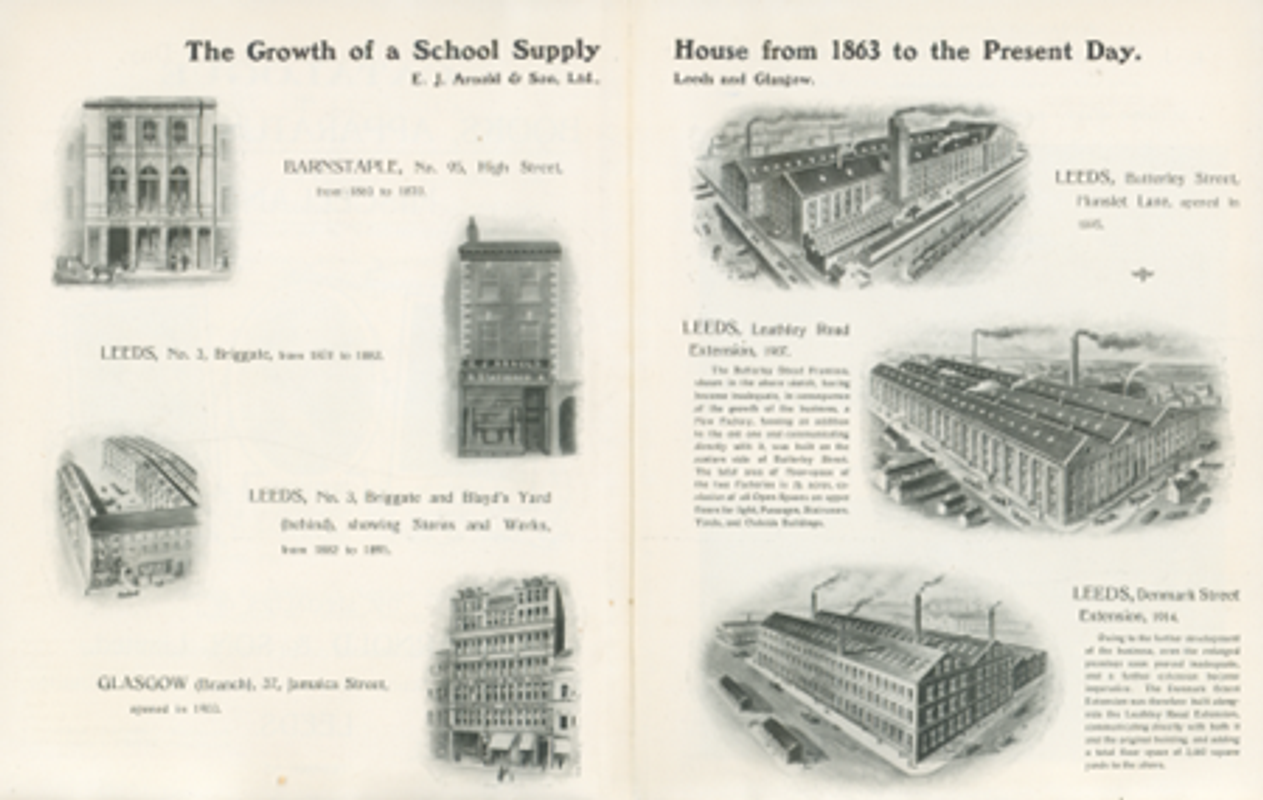
One of the first, and ultimately most influential, people to take advantage of this widening gap was Edmund James Arnold. Born in Devon, he began his career as a printer, stationer, and bookseller in the Dorset town of Barnstaple in 1863, having previously trained in London. There, he published books about the history of the town which were praised for their high standard. Not content with the small, unvarying population of Barnstaple, he moved his company to Leeds in the year 1870, intending to take advantage of its ever-growing metropolitan populace by impressing them with his quality work that rivalled that produced in London. With a quarter of a million people living there, a number which would more than double over the next two decades as Leeds prepared to become a city, it was certainly a shrewd move from the businessman.
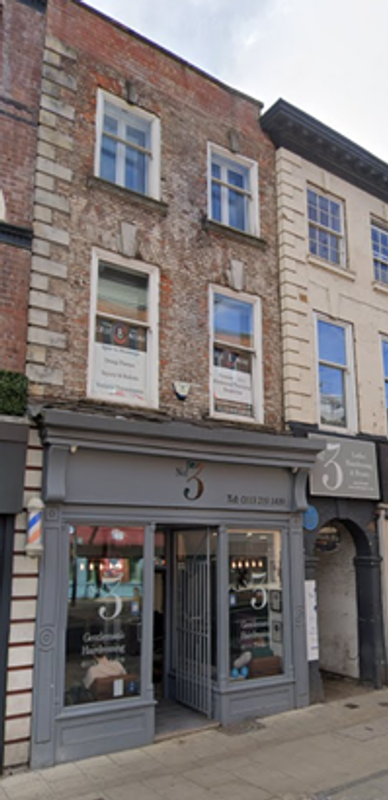
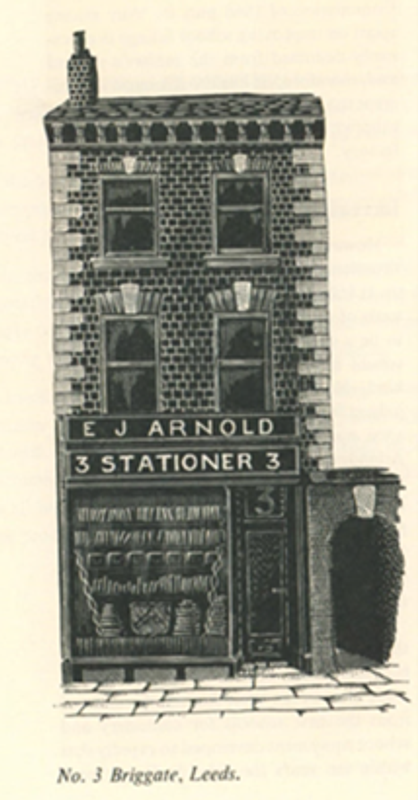
E. J. Arnold’s first Leeds base was at 3 Briggate, which had the benefit of being located adjacent to manufacturing centre Blayd’s Yard, into which the company would expand just six years later. Before this point, industry in Leeds had been focused primarily on textiles and engineering - it wasn’t known for its stationery production. However, with the arrival of Arnold, and the dramatic increase in pupil numbers across the country (from one to six million between 1970 and 1890), Leeds was presented with the opportunity to carve out a new niche. As one of the earliest adopters of educational equipment production, Arnold was able to quickly secure lucrative contracts with the education authorities in Leeds, Bradford, Shipley, Rotherham, and Sheffield, with further contracts spread throughout the country where representatives of the company forged connections, expanding into Wales and the Southwest of England. Within just 10 years, the educational arm of E. J. Arnold had vastly outgrown its adult-focused stationery and book production.
E. J. Arnold had a wide catalogue of supplies available for schools to order. A ‘Catalogue of School Requisites’ published circa 1890 has 264 pages in total, filled with various examples of stationery, books, furniture, and educational equipment. A popular range produced by the company was the Bright Story Readers series of books. Complete with pronunciation guides, mini-dictionaries, historical timelines, and maps, they were an effective educational tool for children. Their popularity can be seen clearly in their production: the series began with 30 books in 1892, and by 1950, there were 375 titles.

New contracts and more products necessitated new premises, as it did not take long for the company to outgrow the confines of Blayd’s Yard and Briggate. In 1878, he acquired a warehouse and factory on Butterley Street. This premises was first expanded in 1907, then again in 1914 with the addition of a new building on the site which gave the company a combined total of 130,000 square feet of manufacturing space. It was sorely needed – E. J. Arnold experienced another significant boom in business following the replacement of school boards with larger Local Education Authorities in 1902, and to match the increase in demand, they hired plenty of new staff. In total, there were 350 employees by 1914, having began with fewer than 100. This period also saw global expansion for the company after they partnered with Macmillan and Company publishers to produce education publications for countries within the British Empire, such as India and South Africa.
1944 marked another pivotal year for the E. J. Arnold company. With the end of the Second World War approaching, there was still no sign of rationing on necessary business materials such as paper being repealed, and it was hard to source parts to maintain their machines. At the same time, a new Education Act saw a new national interest in schools. Children were beginning to stay in school longer than they ever had before, and new developments were being made in special needs education. As a result, a greater variety and depth of materials such as textbooks were required. While the introduction of the act had the unfortunate side effect of ending many schools’ contracts with manufacturers like E. J. Arnold as responsibilities shifted from local to county authorities, the company was able to take advantage of the rapidly evolving education scene in Britain and continue to thrive despite the difficulties and obstacle presented by the war.
Following World War II, E. J. Arnold expanded throughout the UK with new premises designed to speed up the distribution process. This included opening distribution centres in London, Edinburgh, Cardiff, and Belfast, on top of continually expanding their Leeds-based premises throughout the mid-20th century.
Despite their global activities, the tight connection between E. J. Arnold and Leeds cannot be understated. Beyond their business presence, the Arnold family also contributed to the city through their civic activities. George Arnold, the son of Edmund, was the Lord Mayor of Leeds from 1916-1917, followed in 1921 by a five-year stint as the Chancellor of Leeds University. Previously, Edmund had been a member of the University’s Board of Guardians. Other positions held by senior figures of the Arnold family and their company include Magistrate, Leeds Art Collection Fund Treasurer, and numerous Presidencies of various printers’ organisations both local and nationwide. They also raised money for local charities and were known to treat their employees particularly well.
E. J. Arnold’s presence in Leeds could, at one point, be found throughout the city, with premises at White Horse Street, Airebank Mills, Queen’s Road, and Elland Road among others. It ceased to be a family business in the 1980s upon the sale of the company. Today, their legacy can be found in the form of a blue plaque located at their first Leeds home at 3 Briggate, as well as in the countless people who grew up learning from their textbooks and using their equipment.
By Katy Marchant, Collections Placement