Blog | News from the Past: November
In this series created by our volunteer Mel Kerry, they look back on the past with this feature of newspapers, clippings and other ephemera from the Leeds Museums and Galleries collection and explore what news looked like in our city’s past. November’s edition features Victory Day, a Victoria Cross dinner and a hundred years of Leeds.
The King and His People Hail Victory Day
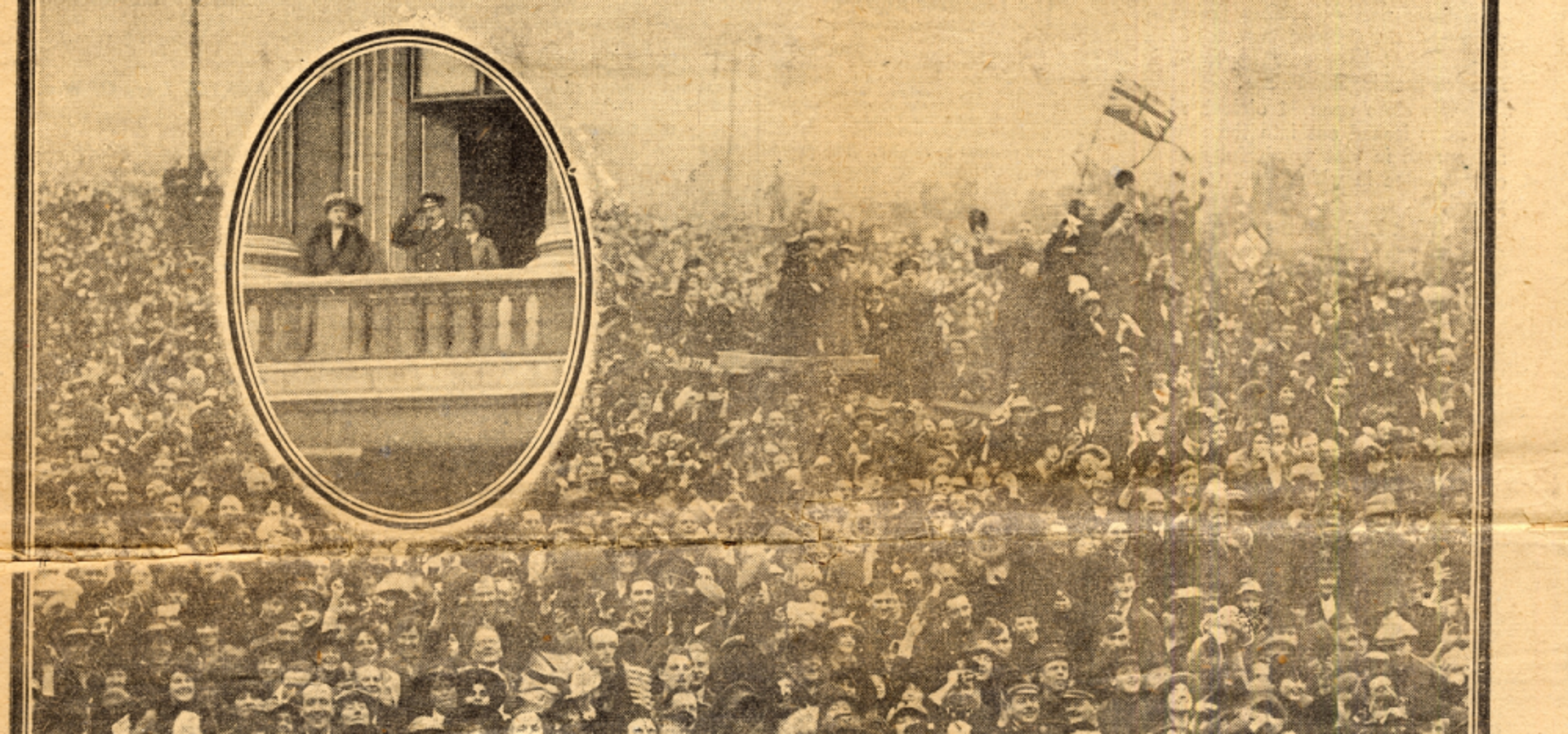
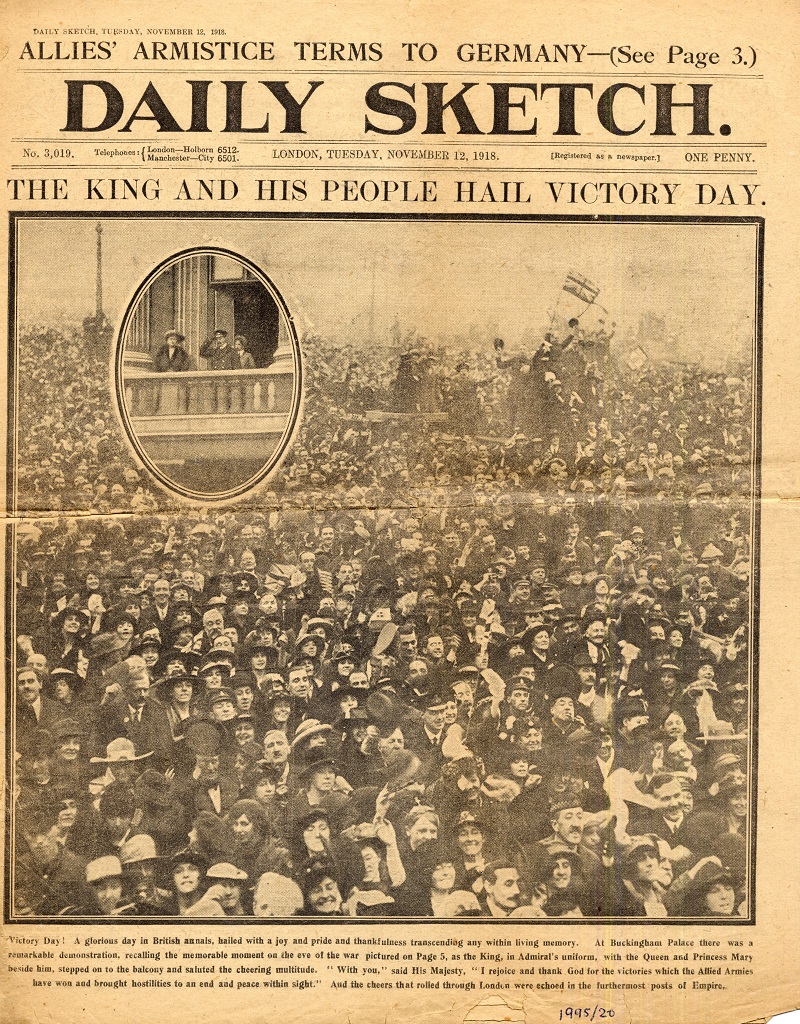 The First World War lasted for four years, from 1914 to 1918, and was fought with deadly new machinery like tanks, warships and aircraft. The end of the war after four terrible years was the news that everyone had been hoping for. On November 11th, 1918, when Germany signed the armistice and agreed to stop fighting, the news of peace was celebrated across the world.
At Buckingham Palace, the King (accompanied by the Queen and by Princess Mary) saluted in front of the people of London. “I rejoice and thank God for the victories which the Allied Armies have won”, he announced to the cheering crowd. The very next day’s edition of the Daily Sketch featured a front-page photograph of the “glorious day”, showing the King’s salute in Admiral’s uniform, the size of the vast crowd, and the waving of the Union Jack flag.
LEEDM.E.2018.0054.0135: Daily Sketch, Tuesday November 12 1918
V.C. Guests for the Prince’s Dinner
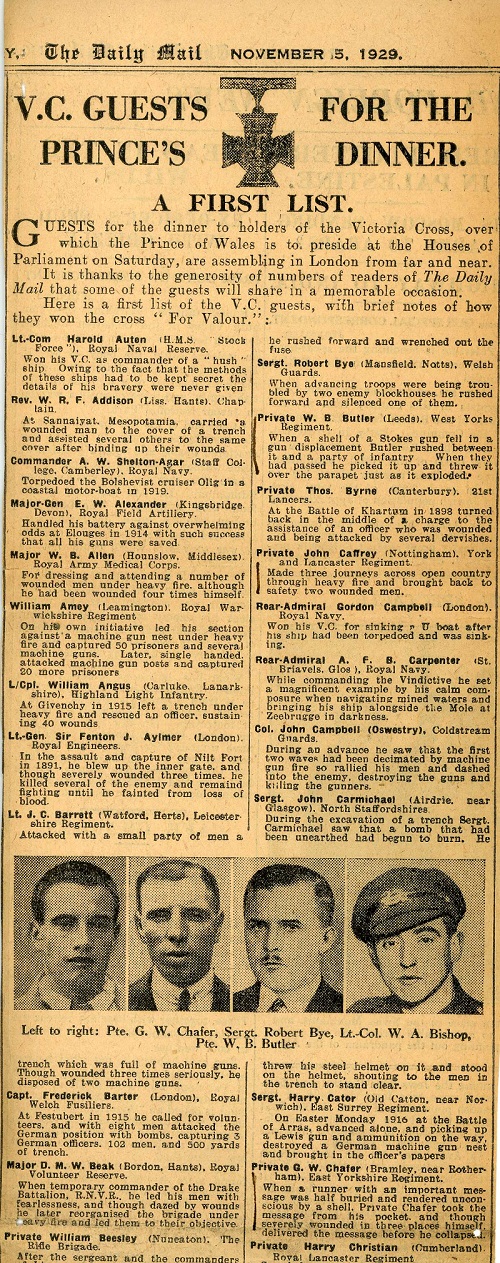 In 1929, ten years since the victory of the World War, holders of the Victoria Cross were invited to Westminster Palace for a reunion dinner with the Prince of Wales. The Victoria Cross is a prestigious (highly respected) medal awarded to members of the British Armed Forces “for valour” to honour extreme acts of bravery and devotion to duty. A total of 628 Victoria Crosses were awarded for acts of bravery during World War I.
Over four days from the 5th to the 8th of November, The Daily Mail published four lists of the V.C. guests to the prince’s dinner and a brief description of how they earned their Cross. Some of these guests would attend “thanks to the generosity of numbers of readers of The Daily Mail.” The guestlist included several servicemen from Leeds, such as Private W. B. Butler of the West Yorkshire Regiment, who was awarded his Cross for protecting a party of infantry from an explosive bullet shell and throwing it away just as it exploded. The list features a photograph of him and his entry is noted in the newspaper clipping.
Also invited to the dinner was Lt.-Col. H. Daniels, member of the Rifle Brigade, who earned the Victoria Cross in 1915 for rushing out under machine-gun fire while wounded to cut through barbed wire for his battalion. His Cross was briefly displayed in Leeds City Museum in 1953 and is now on permanent exhibition in the Winchester Rifleman’s Museum. Dr. Owen, the director of Leeds City Museums at the time, hoped that “Perhaps one of our Leeds-born holders of the Victoria Cross might sometime consider allowing his medals to come to us on an indefinite loan as an example of courage to future generations of Leeds people.”
It was later in 1953 that a Victoria Cross was donated to Leeds City Museum. Flight Sergeant Arthur Aaron was posthumously awarded the Cross for his 1943 act of bravery: when his aircraft was attacked and damaged by enemy fire, leaving him with a broken jaw, torn face and wounded lung, he still made great effort to land the aircraft safely. This made him the only Leeds serviceman to be awarded the Victoria Cross in World War II. His medal, donated by Mr. B. Aaron, is on display in the Leeds Story Gallery of the Leeds City Museum.
LEEDM.E.2010.0268.0027: cutting from Daily Mail 1929
100 Years Anniversary of Municipal Government
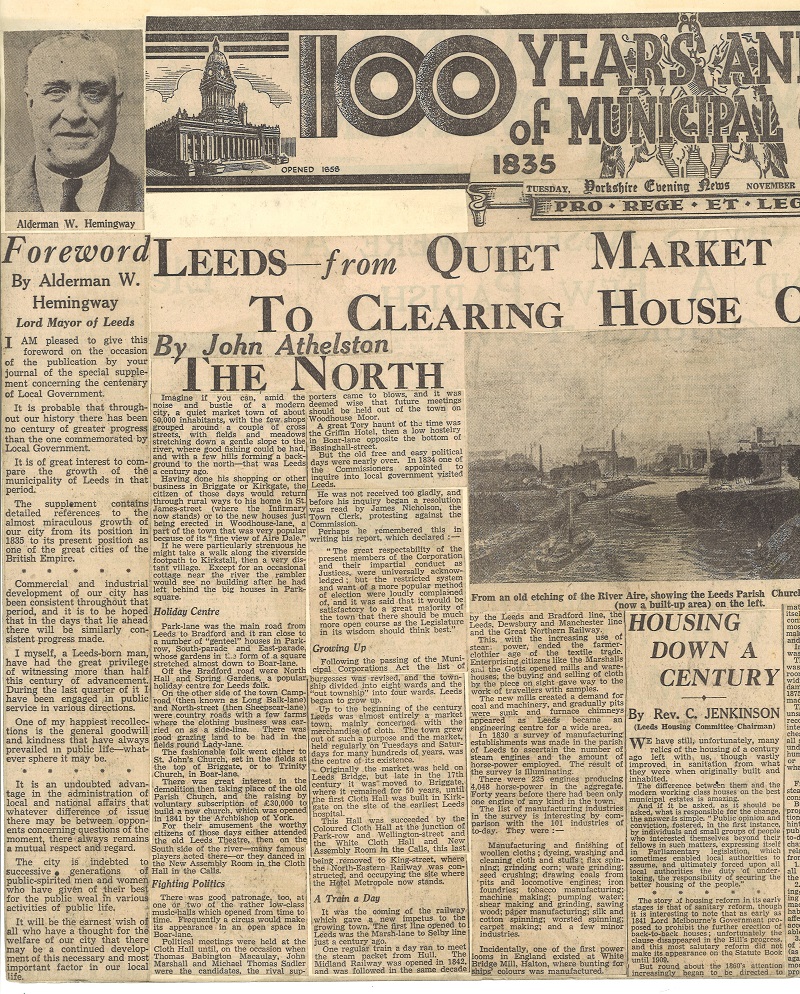 This collection of newspaper cuttings comes from the Yorkshire Evening News special supplemental published in November 1935, celebrating 100 years of Leeds’s local government. The collected articles tell the story of Leeds’s development under local government, “from quiet market town to clearing house of the North” as one headline states.
Leeds became a locally governed town in 1835, when the Municipal Corporations Act of 1835 changed the way that council members were chosen. For each included town, city and borough, the people who lived and paid taxes there would vote for the council and mayor. The first mayor of Leeds elected this way was Sir George Goodman, a member of the Leeds Philosophical and Literary Society who donated several birds to its collection that formed the basis of Leeds City Museum.
The Lord Mayor of Leeds at the time of the edition’s publication was Alderman W. Hemingway, who gave a foreword for the 1935 special edition. “It is probable that throughout our history there has been no century of greater progress than the one commemorated by Local Government,” he wrote. Evidence of the century’s great progress is shown in a list of Milestones of Progress, including Leeds Museums and Galleries milestones such as the presentation of Kirkstall Abbey, the founding of the Art Gallery and the acquisition of the City Museum.
In just 10 years, 2035 will be the second centenary of Leeds’s local government. How much progress have we made so far? How much more progress will we have made by then?
LEEDM.E.1966.0005.0014.217: cuttings from Yorkshire Evening News