Leeds and Colonial Art: A Look into Edward Armitage's Retribution
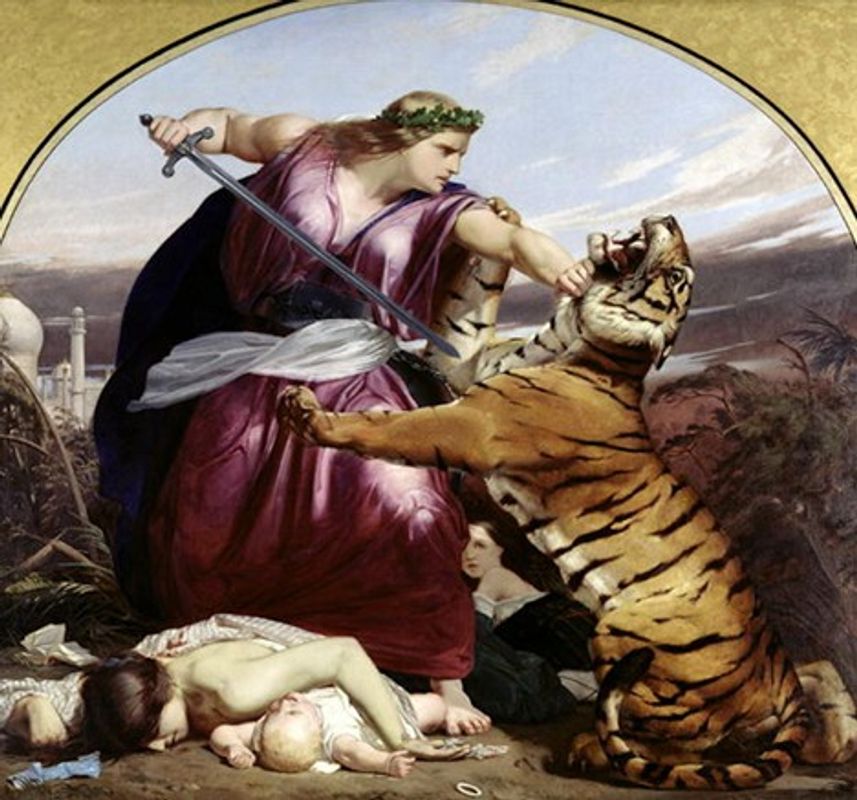
When I first came to Leeds three years ago from India for university, one of the first places I visited was the Leeds Art Gallery. I was about to start my degree in English and Art History, and naturally, the art lover in me wanted to explore the city I'd be calling home for the next three years. I remember being so excited at the thought of discovering new art and culture. So imagine my surprise when the very first thing I noticed upon entering the gallery was this painting by Edward Armitage which seemed very clearly targeted at India, my home country.
The painting is called Retribution by Edward Armitage, and it is really hard to miss. It’s sheer size and placement demands your attention. But for me, someone who had just recently immigrated from India, it demanded something more than attention. I think I speak for almost all Indians, or those with Indian heritage, when I say that the tiger is an incredibly powerful symbol. For many people it is just an animal, but for Indians, a tiger carries the weight of our history, our land, our identity. It is deeply native to us. And I think any Indian who looks at this painting knows exactly what it is about before they even glance at the display board beside it.
My assumptions were, unfortunately, confirmed.
What is the painting about?
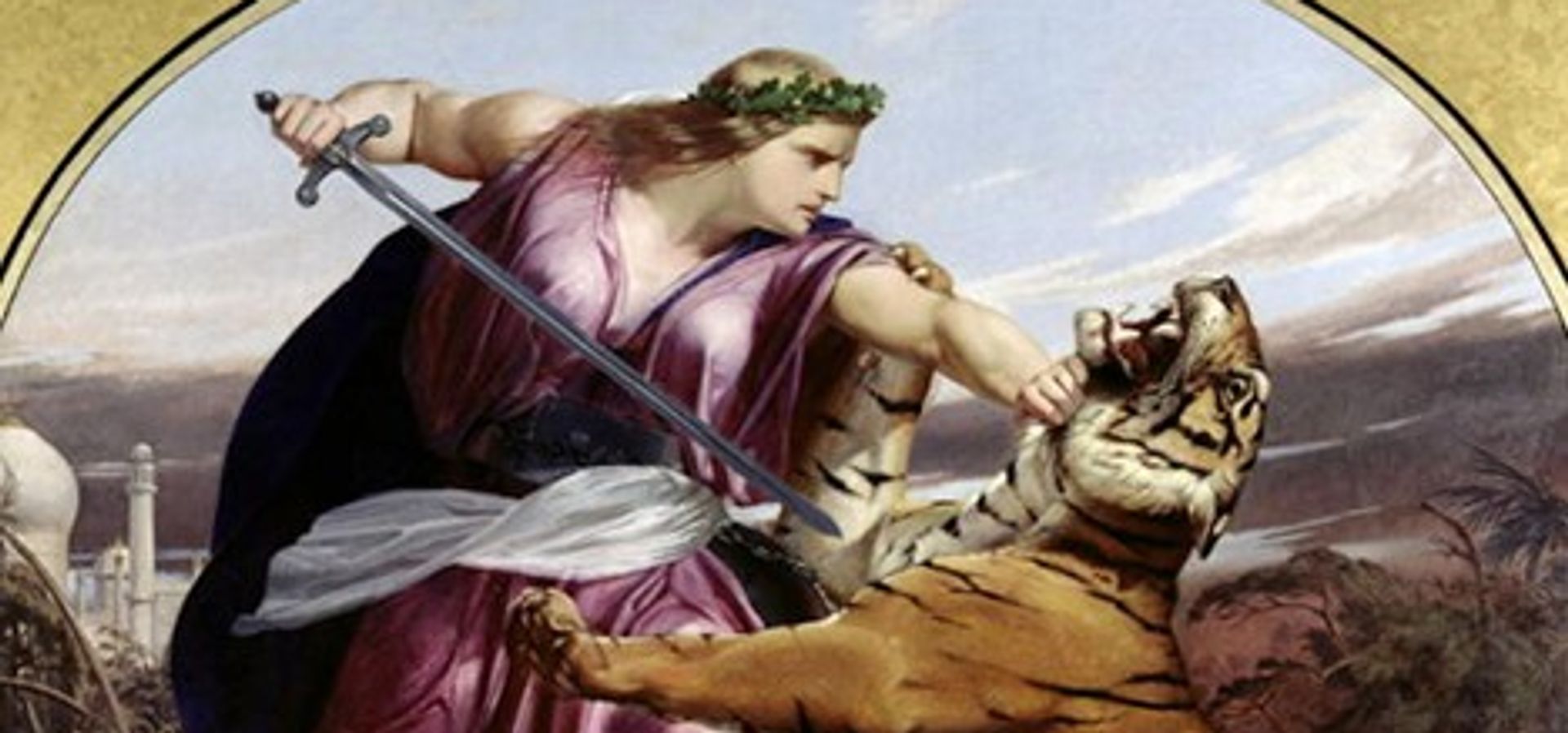
The painting is titled Retribution, and the title leaves little to the imagination. It depicts Britannia, the allegorical figure of Britain hunting down a tiger, which in this context represents India, specifically colonial India. Britannia pursues the tiger as an act of revenge and punishment for the Indian Revolt of 1857. The injured women and child in the scene are likely intended to represent vulnerable British victims of the revolt, with the tiger standing in for the Indian sepoys who fought against the British army.
What is most striking to me about this painting is its unapologetic focus on violence, and what that violence communicates. Indians in this painting have been dehumanised, reduced to an animal, while Britain is portrayed as a powerful, righteous, almost divine figure. It frames an uprising against an oppressive regime as something monstrous and something that deserved to be hunted down and punished. It is very colonial in that aspect. That framing says everything about how colonial Britain understood, and wanted others to understand, what happened in 1857.
The Revolt of 1857
So for those who are not aware, 1857 is an incredibly important time in Indian history, as it was the first major revolt of Indian sepoys against the East India Company (sepoys were Indian troops used by the private East India Company to maintain British control of India). It was triggered by several compounding tensions, but the most immediate cause was a rumour that the cartridges being issued to sepoys were greased with either beef or pork fat which is deeply offensive to both Hindu and Muslim soldiers respectively who formed the majority of the sepoys. This sparked an uprising that would become one of the most significant events in Indian colonial history, now known as the Revolt of 1857, or the Sepoy Mutiny.
The toll on both sides was immense. There were approximately 6,000 British casualties, while the Indian population suffered far greater losses, an estimated 800,000 people were killed or injured. It was a brutal, pivotal moment, and one that is taught to every Indian child from a very young age. Growing up in India, I learned about this history early. The importance of this event to our national identity cannot be overstated.
What is it doing in Leeds?
Which brings me to a question I found myself asking as I stood in that gallery: how did a painting of such profound colonial significance end up here, in Leeds?
The answer is revealing. Retribution was given by Edward Armitage, the artist, to Leeds Town Hall when it opened in 1858, just one year after the revolt. Leeds City Museum was opened in 1865 and Leeds Art Gallery in 1888, when the painting was transferred to this new space dedicated to art. All three of these institutions evidenced the commitment of the Leeds Philosophy and Literary Society to address what had been declared at the moment of its founding a “shameful lack of culture” in the city. This society was founded in 1819 by the upper-class men of Leeds, with the aim of creating a space for the discussion and preservation of science, literature, and art. This was the same era in which the industrial revolution was reshaping the city entirely.
Leeds in the 19th century was an emerging industrial town working hard to establish itself as a place of cultural significance. And in doing so, it reached for a violent colonial event as one of its founding cultural statements. That is not merely a coincidence, in fact it gives us a deeper insight into how deeply colonialism was woven into the fabric of British civic life, even in cities far removed from the front lines of the empire.
But what does it mean today?
This painting rarely makes its way into broader conversations about colonialism beyond Leeds. In some ways, I think that is precisely what makes it so significant. It shows how colonial ideology didn't just exist in parliament, or in trading companies, or on the battlefields of India, it seeped into local institutions, local galleries and local identities. When I first immigrated to the UK for my studies, I did expect to encounter remnants of the colonial past here and there, however I was not prepared to encounter it so casually in a city I did not even hear of in conversations of colonial Britain while growing up. But this painting is a reminder of how colonialism as a symbol of power found its way into a Yorkshire town hall.
This brings me to the ongoing debate around decolonising museums, a conversation I find myself thinking about often. Should museums return art to its place of origin? Should they rewrite their display boards? Change their language? These are all valid questions, but my honest view is this: simply removing a painting does not decolonise a museum.
The Leeds Art Gallery and Leeds City Museum were born from the industrial revolution, from colonisation, and from the cultural and economic consequences of both. The buildings themselves, their architecture, their infrastructure, their very foundation all of it is part of that history. You cannot dismantle that history by taking a painting off a wall.
What concerns me equally, though, is the opposite approach: the idea that representation alone is enough. Reproducing a colonial artefact within the same colonial institution, under the same institutional gaze, does not fundamentally change how it is displayed or how it is received. It risks simply recycling colonial frameworks with a modern but equally less understanding of decolonisation.
Right now, at this moment it has been around three years since I have been studying art history in Leeds, and I have learned a lot throughout my time here and what I can say is that art is always meant to be questioned. It is meant to be understood both historically and politically through different lenses for it to “make sense”. Museums are not just places for pretty paintings to be admired at and this is something I learned very early on when I first came here to study, instead they are real cultural and historical institutions where every painting and artefact each carry their own story as evidenced by Retribution.
I would therefore like to ask the readers of this blog that the next time they visit a museum, to look at painting not only through aesthetics but also question it. Question and challenge yourself on what that painting does to you and how did this art find itself in this museum. The goal is not to find answers but to open conversations, ones that engage with institutions critically, historically and on a human level.
By Thoi, member of the Preservative Party